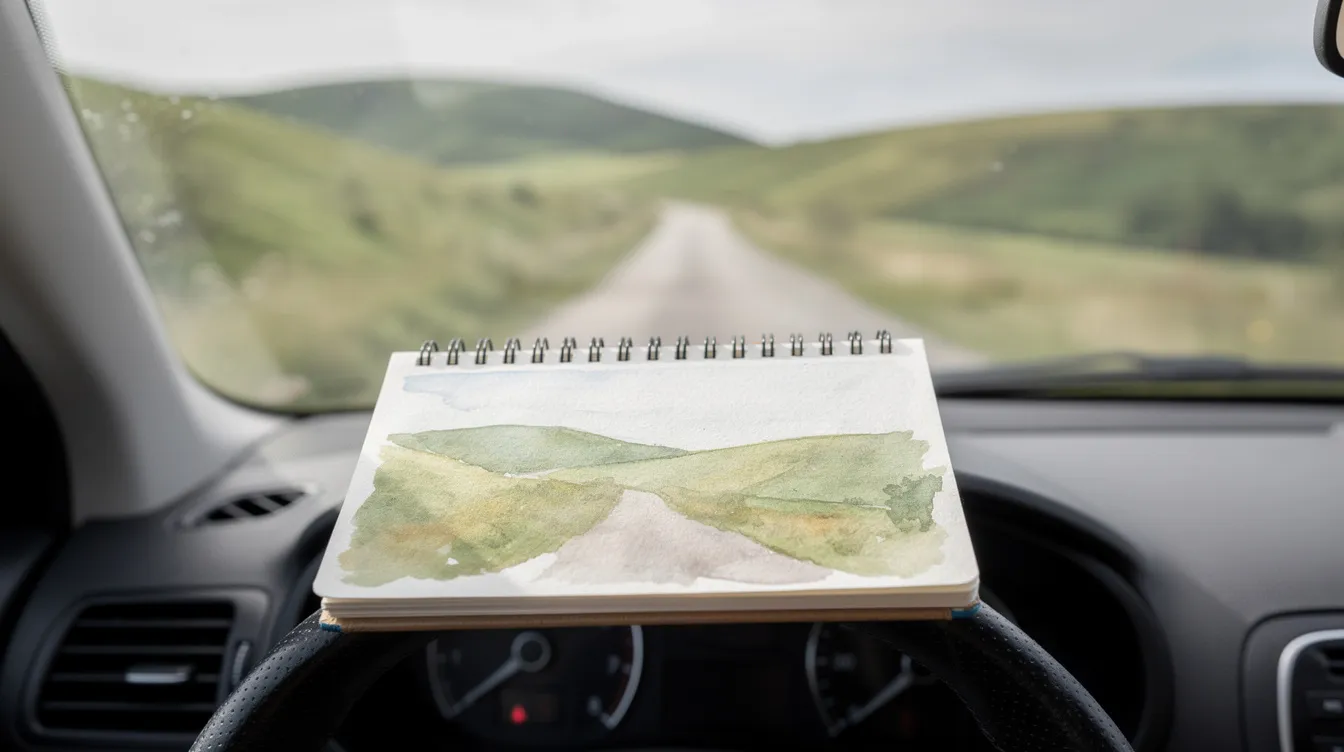
A watercolor journal is one of the simplest ways to slow down, pay attention and remember what you saw. Here is how I started mine from a van’s glovebox, and how you can start yours with very little gear.
Why I Keep A Watercolor Journal On My Rural Mail Route
I’m Wanda, and I write Fern and Pencil. I deliver rural mail on a route outside Nelson, at the top of New Zealand’s South Island, five mornings a week. My watercolor journal lives in the van’s glovebox along with a small paint tin, two brushes and a pencil. I have kept it for six years now.
It began with a shoebox of my grandmother’s pressed ferns, each one taped to a card with a date and place in her small handwriting. I tried to draw one at the kitchen table with a flat grey pencil, then added a dab of green paint from a child’s set. That first attempt was a mess. The green pooled, the paper buckled, and the frond looked like a squashed caterpillar. I wanted to try again the next morning, and I have not really stopped.
On 12 June 2023 I pulled over near the Maitai River between deliveries. A kingfisher sat on a wire fence post, still enough that I had maybe four minutes before it flew. I got the shape down in pencil, laid a wash of cerulean and raw sienna, wrote “kingfisher, Maitai bend, 11:40, light rain” and drove on. That page is not gallery art. It is a memory I can hold in my hands, and capturing a scene through watercolor can evoke sensory memory more strongly than a photograph.
A watercolor journal, sometimes called an illustrated journal or an art journal, is simply a notebook where you mix written notes and quick watercolor sketches on the same pages. If the idea is new to you, start with what nature journaling is. This post is practical, beginner-friendly and not a formal lesson. Fern and Pencil is a hobby blog with no sponsors or affiliate links, just what has worked in my own watercolor sketchbooks.
Choosing A Watercolor Journal That Loves Water As Much As You Do
Ordinary notebook paper buckles and pills when wet. Thin paper can make you blame your skill when it is only the paper. Using a dedicated watercolor sketchbook prevents warping and bleeding from water, and that alone makes a big difference to how your pages feel.
The most important number is paper weight. Watercolor journals should use paper of at least 140 lb (300 gsm) for serious washes. That weight handles multiple layers without curling into a tube. If you try 90 lb (about 190 gsm) with lots of water, expect buckling. That said, 90 lb paper is suitable for light watercolor washes and dry brush work if you keep things gentle.
My advice: spend money on paper before paint, because good watercolor paper makes cheap paint look better than the reverse.
Sizes I have used:
-
A6 pocket book fills fast but fits a shirt pocket.
-
5.5 x 8 inches is my go to size. A 5.5 x 8 inch journal size is ideal for beginners because it gives enough room for a sketch and a few sentences without feeling like you have to fill a canvas.
-
8 x 10 inches is nice for full spreads but heavy in the glovebox.
Spiral-bound journals lie flat naturally for easier painting, which matters when your desk is a steering wheel or your knee. Hardbound books look lovely but fight you when you try to open them wide. Hand-stitched pamphlets are light but hold fewer pages. For notes plus small watercolor panels I prefer a mid-sized spiral sketchbook that lies flat without a fight. I own two formats right now: a spiral A5 with 300 gsm cold press pages, and a pocket hardbound I keep for pencil-only field notes. I am not selling anything, just telling you what sits in my van.
Understanding Watercolor Paper Without Getting A Degree In Paper Science
Three choices matter for a beginner: surface, weight and cotton content.
Surface
-
Cold press paper has a slightly bumpy texture that grips pigment well. Cold-pressed paper is most forgiving for beginners because washes settle into the tooth and edges look natural, not harsh. It works well for loose nature washes, wet-on-wet skies and botanical texture.
-
Hot press paper is smooth, almost slick. It is kind to fountain pen writing and fine plant details, but careless washes can dry with harsh edges and visible pooling. I use hot press when I want crisp ink lines and only a light tint of color.
-
Rough paper has deep valleys in the surface. It creates beautiful dry brush texture on bark or stone, but pen lines break across the bumps, so I skip it for journal pages where I also write dates and field notes.
Cotton versus wood pulp
One hundred percent cotton watercolor paper has long fibres that hold up to lifting, scrubbing and masking fluid. Wood pulp mixes are cheaper but degrade with repeated wetting and can yellow over time. I once painted the same silver fern leaf on cotton and on student-grade wood pulp paper. Months later, the cotton page still looked clean. The wood pulp page had faded slightly and felt stiff.
For a daily journal, the quality and cost trade off is real. Buy the best you can comfortably afford. Cotton is worth it for pages you want to keep.
Watercolor Sketchbook Or Loose Sheets: What Actually Works On The Road
One windy afternoon near Atawhai, I had three loose sheets of watercolor paper on my lap in the driver’s seat. A gust caught the top sheet and sent it spinning toward a paddock full of sheep. I chased it over a fence. Since then I have been a sketchbook person.
Bound watercolor sketchbooks keep the story of your year in one place. Pages stay together, you can flip back and compare, and nothing blows away. The trade off is that a buckled spread from a heavy wash can be awkward, and some bindings refuse to lie flat.
Loose sheets or blocks dry flatter at home, and you can choose different brands of paper each time. But loose sheets create piles of unfinished pieces and are miserable in wind.
My compromise: I carry one main sketchbook plus a few trimmed scraps of watercolor paper tucked into the back pocket for testing colors or experimenting with a new pigment. If you paint mostly on the sofa or at a picnic table, loose sheets may suit you fine. If you paint from a car, bus or park bench, a bound book is simpler.
Simple Watercolor Supplies For A Nature Journal (No Studio Required)
This is about a light, affordable kit that fits in a glovebox or a small bag. Skip the big palettes, the fancy easel and the dozen brushes, because more choices slow a beginner down. Watercolor is a portable and easy-to-clean medium compared to oils or acrylic, which is one reason it suits field sketching so well.
Paint
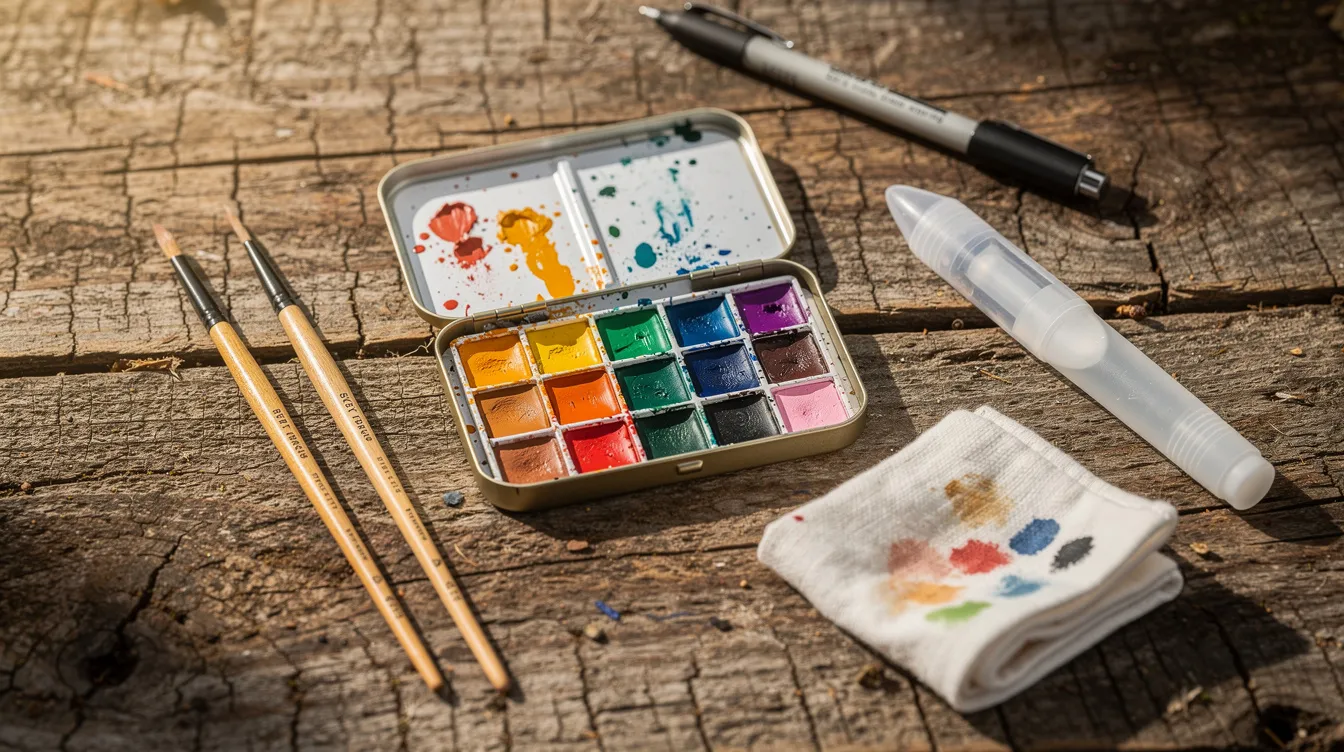
A pan palette of 8 to 12 colors is plenty. Six to eight colors are sufficient for a beginner’s watercolor palette if you are willing to mix your own colors. Pans are dry cakes of watercolor paint you wet with a brush, so nothing to squeeze or spill in a van. Student grade is fine to start. In my travel tin I carry 12 half pans: a warm and cool yellow, two reds, two blues, yellow ochre, burnt sienna, sap green, viridian, Payne’s grey and a white gouache for small highlights. Watercolor is pigment in a binder, traditionally gum arabic, which is why a dry pan revives with a wet brush. For the history behind the medium, see the Wikipedia article on watercolor painting.
Brushes
Two brushes to start:
-
A medium round brush, size 6 or 8, with a good point for washes and larger shapes. A medium round brush size 6 to 10 is essential for journaling.
-
A small round brush, size 2 or 3, for tiny leaves, details and fine lines.
A water brush, which has a squeezable reservoir, is useful for quick stops because water brushes eliminate the need for a separate water jar. I pair one with a small screw-top jar on my route so I have both options.
Line work and extras
A waterproof fineliner pen keeps ink from bleeding when you add watercolor washes over it. Waterproof ink is essential to prevent bleeding. I use an HB pencil rather than soft pencils because soft leads smear into wet washes. A rag or folded paper towel for blotting, a bulldog clip or rubber band to keep pages open, and a pencil case that holds everything. A minimal supply setup is adequate for starting watercolor journaling.
Masking Fluid, Tape And Other Helpers: When You Actually Need Them
Masking fluid and other resist tools are optional, and they become fun once basic washes feel comfortable. Masking fluid is a rubbery liquid you paint onto areas you want to keep white. Once dry, you paint over it freely, then peel or rub it away to reveal clean paper beneath. It is good for glossy leaf highlights, bird eye reflections or river sparkle.
In January 2024 I used masking fluid to keep tiny white koru shapes in a fern study. I painted the fluid onto the curled tips with an old brush, let it dry completely, laid two green washes over the whole frond, then peeled the dried masking away. The white spirals glowed against the green. A stencil effect without a stencil.
Tips: use an older brush because masking fluid ruins good ones. Do not scrub when removing it. Make sure the page is fully dry before peeling. Low-tack tape along the edges gives clean borders. Wax crayons or oil pastels work as a simple resist for a collage-style look.
If you are just starting, you do not need masking fluid on day one. You can reserve whites by painting around shapes, which teaches you to plan your washes.
Starting Your First Watercolor Journal Page (Without Freezing Up)
A journal offers a private space for low-pressure creative exploration. Creating art without focusing on perfectionism helps relieve stress and anxiety. So do not let the blank page scare you.
Start with a swatch page. Paint small rectangles across the top of a page, writing each color name and the date beside it. Test on a scrap too, because watercolor dries lighter than it looks when wet. Swatches are an easy way to add watercolor to pages and they give you a reference you will use for months.
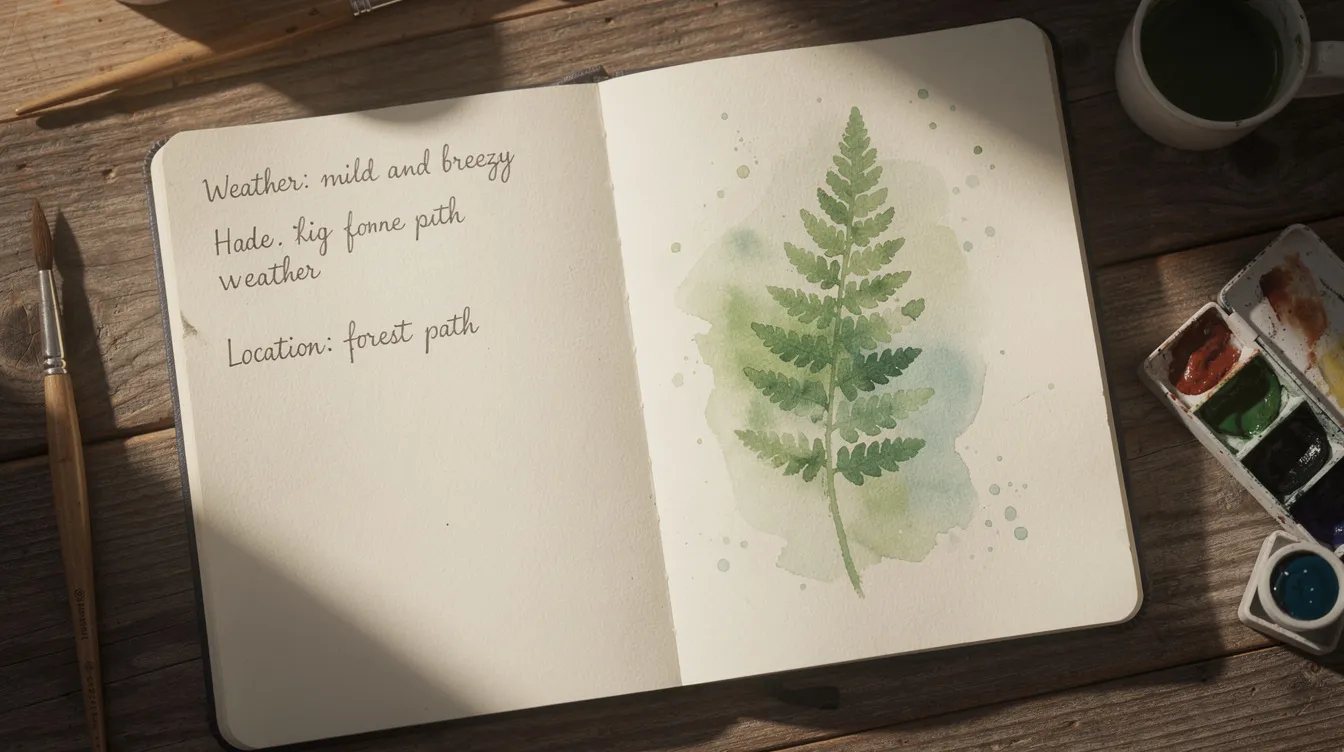
For your first real spread, pick something small and still, like the bracken frond I started with from the verge by a gate. Birds and clouds are too fast for a first go. On the left side, sketch and paint the leaf. On the right, write a few sentences about the day’s weather and what you noticed.
Step by step:
-
Draw faintly in pencil as a map for the paint. If a line is wrong, draw the right one beside it.
-
Paint the lightest wash first with lots of water and little watercolor paint. Let it dry.
-
Add one or two darker layers for shadow or detail.
-
Stop sooner than you think you should. Three confident washes beat fifteen nervous ones.
Mistakes I made so you can skip them:
-
Too much pigment and too little water. My first leaves looked like green plastic.
-
Pushing half-dry wet paint around until the edges went blotchy. If the surface is damp, either add more water or wait until it dries. Do not poke at it.
Treat the first page as practice. In my 2020 journal I splashed muddy greens across multiple pages that I now treasure because they show where I started. Mix written notes in from the start, even just labels, place and time. Layering text over watercolor adds depth to journal entries and gives your future self the story behind the drawing. Painting ordinary objects can help develop a watercolor journaling habit, so do not wait for a spectacular scene.
Here is a prompt to try: on your next walk, stop for five minutes to paint the shape of just one tree trunk and write three words about the sound around you. Prompt-based journaling facilitates creativity and expressive practice, especially when you feel stuck.
Everyday Ideas To Add Watercolor To Your Journal Pages
These ideas work for both dedicated watercolor sketchbooks and mixed-media art journals:
-
Rows of leaf swatches across a page, labeled with the plant name
-
Loose sky gradients painted wet on wet at dusk
-
Splotchy rain clouds in grey and blue. Splotches create an artsy, painterly vibe on pages
-
Quick bird silhouettes perched on power lines
-
Geometric shapes filled with color swatches to enhance journal designs
-
Color mood tracking at the start of an entry, a small circle of whatever color matches how you feel. Mixing colors in watercolor encourages immersion in the process and reduces overthinking
Text and color together:
Paint a soft wash behind a quote or title. Add a band of color along the margin. Use tiny watercolor circles as bullet points. Experiment with style and see what suits your pages.
New Zealand seasonal prompts:
-
September: kowhai blossoms, bright yellow against bare branches
-
July: bare willow branches along a river, fog on the hills
-
December: golden dry grasses, cicada noise, long shadows
Try theme pages too. “All the greens on my street” is one of my favorites. Or “five birds from this month” or “shapes of stones from the riverbank.” Messy swatches and splotches are still real watercolor art and become precious reference later.
Combining Writing, Field Notes And Watercolor In One Art Journal Spread
A watercolor art journal is not only for pictures. Words deepen memory and observation. Years later my notes bring a morning back more vividly than the sketch does. “Wet gravel, fog on the hills, fantail in the hedge” takes me straight to a Tuesday in June.
My typical spread: a watercolor sketch of a plant on the left, notes on weather, bird calls and location on the right. Layout options include a small vignette in one corner with writing around it, or narrow watercolor borders framing entries. Art journaling helps process emotional responses to events, and even a short list of what you saw, smelled and heard beside a simple wash counts.
Record exact dates, place names like “Cable Bay lookout” instead of just “the bay,” and small arrows pointing to plant parts with labels. Try block letters on dry color bands or tiny pencilled notes over pale washes. Engaging in watercolor journaling helps improve emotional regulation, partly because paying attention to details forces you into the present moment. Combining watercolor and journaling can capture emotions and memories in a way that plain text alone does not.
Nature journaling is about recording more than a pretty picture. It is about noticing, and letting the noticing change how you see ordinary places.
Developing A Gentle Watercolor Journaling Habit
Using watercolor encourages a mindful, present state of creation. But that only works if you actually open the book. My rhythm is a few pages a week between sorting mail and the last stop, not daily journaling under pressure. A quick sketch on most days I have a spare ten minutes, usually at a lunch stop by a paddock or river bridge.
Realistic time frames:
-
5 minutes: one wash, a date, a single color note
-
15 minutes: a small nature study with two or three layers
-
30 minutes: a full spread with drawing, paint and writing
In February 2022 I managed three short entries in one week. Monday was a seed head in burnt sienna. Wednesday was a sky gradient that went too dark. Friday was a fence post with lichen, and I loved it. Each felt completely different. That is part of the fun. Art journals enhance personal expression and creativity because no two pages need to look alike. Art journaling also encourages exploration of new techniques and materials, so let yourself experiment.
Keep your supplies packed in one spot, a bag by the door, a drawer, a glovebox, so starting a page is as easy as putting the kettle on. Gaps are normal. Turn the page without guilt or catching up. Watercolor journaling blends mindfulness and creative expression, and that blend works best without pressure.
A simple first week plan:
|
Day |
Activity |
|---|---|
|
Day 1 |
Swatches of every color, with names and date |
|
Day 2 |
One leaf in one color |
|
Day 3 |
Same leaf in two colors |
|
Day 4 |
Window view plus weather notes |
|
Day 5 |
A loose wet-on-wet sky |
|
Day 6 |
A seed, shell or pebble and its texture |
|
Day 7 |
Flip through your pages and circle one thing you like on each |
The hardest part for most people is simply getting started outdoors. It is about paying attention to ordinary places and letting the drawing follow. Sketching your way into nature does not require a grand landscape, just a willing eye.
Learning From Your Own Pages Over Months And Years
I sometimes flip through old watercolor sketchbooks from 2019 and find clumsy ferns beside brave color choices. The ferns are wonky, the washes are muddy, but the color was bold. Art journals can serve as a record of personal growth over time, and reviewing older journal pages shows progress in brush control, color mixing and confidence. Keep the ugly pages, because they show what to change next time.
One concrete comparison: an early silver fern page from 2020 had flat green, no contrast, and blotchy edges. A silver fern from 2024 had clean layers, warm and cool greens, sharp leaf tips and a confident wash beneath. What stayed charmingly imperfect both times was my handwriting. Watercolor journaling can boost memory retention by engaging both visual and analytical skills, and dates make that visible.
Add dates, seasons and occasional notes on what supplies you used so those pages become useful reference. Set aside an evening every few months to leaf through your own watercolor journals, marking favorite pages with sticky notes for future inspiration. Keeping an art journal can make life feel richer and more meaningful, and this quiet review is where you feel that most.
A watercolor journal is less a gallery and more a story of learning to see.
Closing Thoughts: Your Own Watercolor Journal, Wherever You Are
You do not need perfect skill or expensive gear to keep a watercolor journal that matters. Most people already have a pencil, and the rest fits in a small bag. This is a medium that travels well, cleans up with water, and forgives more than you expect.
I write from the perspective of a rural mail carrier and hobbyist in New Zealand. If I can fit watercolor sketching and a journal into a glovebox between deliveries, it can fit into most lives. Start with the journal and paper you already have, add watercolor in small ways, and let your own watercolor journals grow one page at a time.
Here is a gentle challenge: choose one day this week, note the date on the page, paint a tiny patch of the sky you see, and write one sentence beneath it. That is your first page. Everything after it is just more of the same.
FAQ
Do I need to know how to draw before I start journaling with watercolor?
No. A simple outline in pencil is enough, or you can paint shapes first and add pen or pencil later. Looking closely at your subject improves your drawing faster than any course. The artwork does not need to be perfect to be valuable.
What is the cheapest way to begin?
A small student pan set, one round brush, an HB pencil and a pad of watercolor paper or a mixed-media sketchbook. You do not need to spend money on artist-grade supplies right away. Spend on paper first, because good paper makes everything else look better. You can fill pages for less than the price of a business card holder.
Why does my paper wrinkle when I paint?
Thin paper swells when wet media hits it. Use less water, heavier paper (140 lb or more), or tape the page down with low-tack tape. Some wrinkling is normal in a journal and does not ruin the page.
Can I paint outside in cold or damp weather?
Yes, but wet paint dries slowly in damp air, so keep washes small. Some days I sketch in pencil and add color at home from my notes. The process still works even split across two sittings.
How long should a journal page take?
Ten to twenty minutes is plenty. Short sessions keep it enjoyable and give you more pages over time. There is no rule. Five minutes with a single wash and a date is still a real entry.