I get asked this question a lot, usually by people who tried once, used one red pencil, and ended up with something that looked like a stop sign on a stick. I know because that was my first attempt too.
Quick Answer: What Trees Have Red Leaves, and When?
On my Nelson mail route I slow the van for red leaves more than I should. The trees I sketch most often are Japanese maples such as ‘Bloodgood’ and ‘Atropurpureum’, red maple, scarlet oak, smoke tree ‘Royal Purple’, and purple leaf sand cherry. Some of these produce red leaves only in autumn. Others carry purple foliage or deep red tones from spring right through the growing season, which means you can draw them for months.
Here is my short answer to the title question: do not use one red. Lay a yellow or orange underneath, build a red on top with short flicking strokes, and push the shadows with something cool like purple or brown. Draw clusters of leaves rather than outlining every single one. Three or four clumps of foliage with a handful of individual leaves picked out along the lit edge will look more like a real tree than two hundred careful outlines ever will.
Every autumn the liquidambars and maples along one stretch of my route make me ease off the accelerator. These trees are regular subjects in my nature journal. The rest of this article covers how to recognise them, when to look for red color, and how to sketch them simply with a small kit and a bit of time.
Why Do Some Trees Have Red Leaves at All?
I am not a scientist. I am a mail carrier with a sketchbook. But understanding what is happening inside a leaf changed the way I draw them.
Leaves contain three pigment groups that matter here. Chlorophyll makes them green and runs photosynthesis through summer. Carotenoids sit quietly in the background producing yellow and orange tones, visible only when chlorophyll fades. Anthocyanins are the red and purple pigments. They are newly synthesized pigments produced during autumn in many tree species, not leftovers from summer. Leaves turn red in autumn because of the production of a pigment called anthocyanin, triggered when trapped sugars in leaves cannot move out easily. Bright, sunny days enhance sugar production in leaves, while cool autumn nights slow sugar movement out of them. That combination of warm temperatures during the day and cool nights is what creates the most brilliant red autumn foliage.
Shortening days signal trees to prepare for winter, and the intensity of red autumn colors is influenced by both genetics and environmental factors. Trees actually expend energy to produce anthocyanins for red leaves, so there must be a payoff. Red pigments may assist trees in nutrient recovery before leaf drop, and red leaves may protect trees from excessive sunlight during autumn while the tree reabsorbs what it needs. Some researchers note that red leaves can attract seed-dispersing birds to trees as well. Some trees produce red leaves due to environmental stressors like drought or poor soil, and red leaves often appear in response to cooler temperatures even before full autumn arrives.
The ability to produce red leaves varies among tree species. Not all trees produce anthocyanins; only about 15 percent can do so in autumn. Most trees turn yellow or brown instead. I have read that North American and East Asian forests often flame red, while much of European woodland leans yellow. The Wikipedia article on autumn leaf color is a readable starting point if you want the science, and it helped me understand why one tree can show so many shades at once.
My first red tree drawing was that stop sign I mentioned. Real red foliage is never one red. Some leaves glow orange with sunlight through them, others sit in shade and go nearly maroon, and a few stubborn green leaves or yellow ones stay in the mix. Once I saw that, I stopped reaching for a single pencil.
Trees with Red Leaves in Autumn
One April morning on a delivery run outside Nelson, a single red maple stood out like a flare among pasture and pines. I parked for five minutes and filled half a page. That was the start of a full season of leaf sketches.
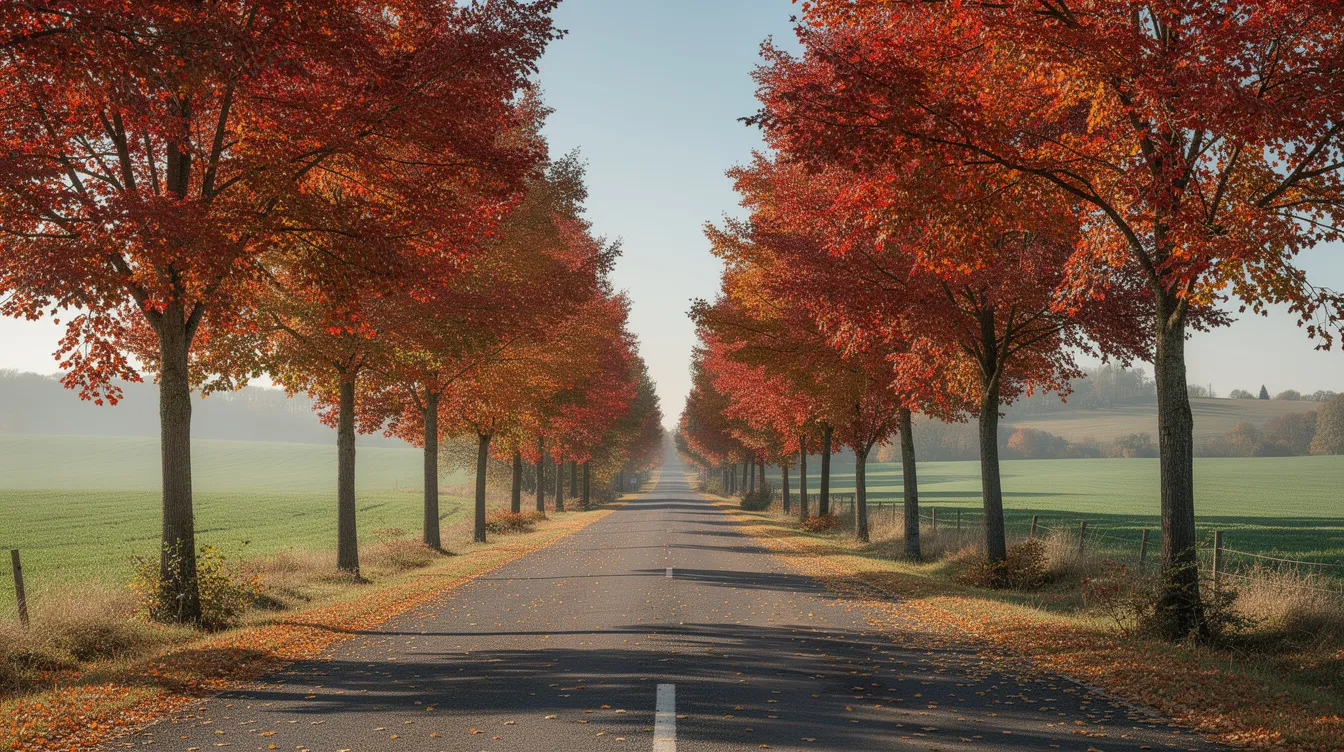
Weather in late summer and early autumn shapes how strong the fall color will be. Sunny days and cool nights produce the best reds, so the same tree can look dull one year and spectacular the next. Certain tree species produce dramatic red autumn foliage under the right conditions. Red maple is the classic: green leaves all growing season, then vivid scarlet or crimson in fall, with a lobed leaf shape that is satisfying to draw. Scarlet oak gives you deeply cut lobes, bright red leaves that can persist on branches into early winter, which is a gift if you come out late in the season.
Beyond those, black gum trees usually bear bright red leaves in autumn. Sourwood trees exhibit striking bright red leaves in fall. Northern red oak leaves are almost always some shade of red. Sugar maple trees often produce bright red leaves in fall, while white oak trees often produce deep, dark red leaves. Other varieties, including fruit trees and ornamental cherries, show streaks of red too.
I simplify all these reds, maroons, and orange leaves into one warm “red family” on my color chart, and I always keep a few green leaves in the picture so the reds look redder. That striking contrast between red and green does more work than any extra pencil. If my greens come out flat, mixing greens for leaves in watercolor is the next thing I would read. Autumn red is temporary, so I keep a small envelope in my journal for pressed samples labeled with tree name, date, and site.
Trees with Red or Purple Summer Leaves
In the Southern Hemisphere, January and February are the middle of summer. Seeing a tree with leaves already deep red or purple in those months, long before any fall color is due, always stops me.
When gardeners say purple foliage they usually mean leaves that read as maroon, wine-red, or blackish purple at a glance, even if the underside or new growth is a bit greener. Cabbage Tree ‘Atropurpurea’ has red leaves year round. Eastern Redbud ‘Forest Pansy’ features purple leaves in summer. Flowering Plum ‘Thundercloud’ has purple-red leaves through the warm months. These trees keep their color from leaf-out to leaf-fall, making them reliable focal points in a garden or landscape all season. But sustained red or purple can fade if the tree sits in dense shade or is under stress, so when I draw a nearby specimen I check whether it looks duller than its description and note that in the margin.
Japanese Maples and Other Favourite Red-Leaved Trees
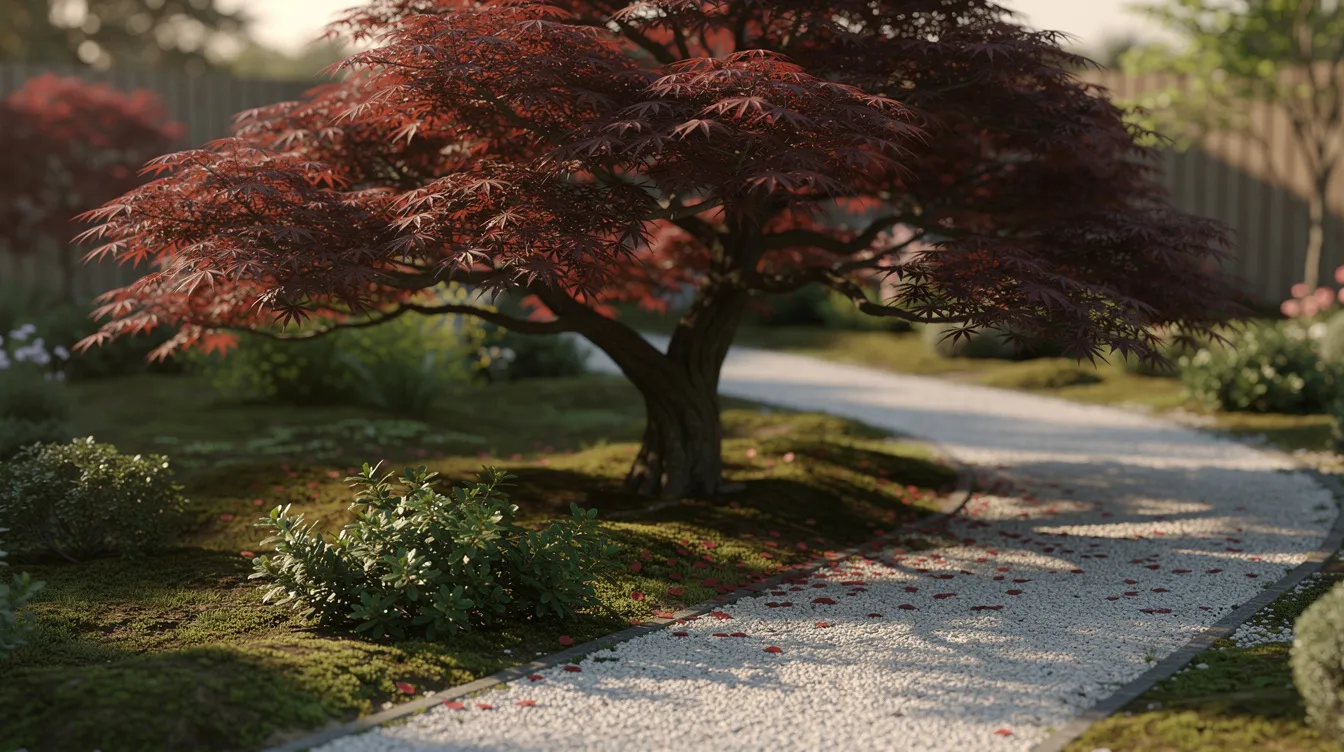
Japanese maples are my favourite trees to draw. Along quiet driveways and small gardens on my route I can park for a minute and sketch their branching structure without blocking traffic. They are modest in height, graceful in shape, with finely divided leaves that reward close looking. Most maples in this group thrive in well drained soil with some shelter, and many do well in large containers on a porch or beside a front step.
‘Atropurpureum’ leafs out in deep purple in spring, then glows scarlet in autumn, giving two different red moods to capture. Japanese Maple ‘Bloodgood’ retains blood-red leaves throughout summer and turns crimson-red in autumn; dappled shade can help it hold its leaf color in hot climates better than full sun. The compact ‘Red Pygmy’ has narrow, strap-like leaves and a rounded canopy, good for sketchers who like to sit close to their subject.
Among other red-leaved trees I have sketched: Norway Maple ‘Crimson King’ has glossy purple leaves that stand out against any landscape. Smoke tree ‘Royal Purple’ carries dense, rounded foliage in deep purple that goes more brownish in intense sun and redder in cool, mild conditions. Purple leaf sand cherry is long lived for its size, with dark leaves, pale spring flowers, and a shape that fills a yard corner nicely. If you prune it lightly and mulch the roots each season, the foliage stays rich. These are some of the best trees for a journal spread because their color is visible from a distance and consistent enough to revisit.
Observing Red Leaves Up Close: Shape, Light, and Texture
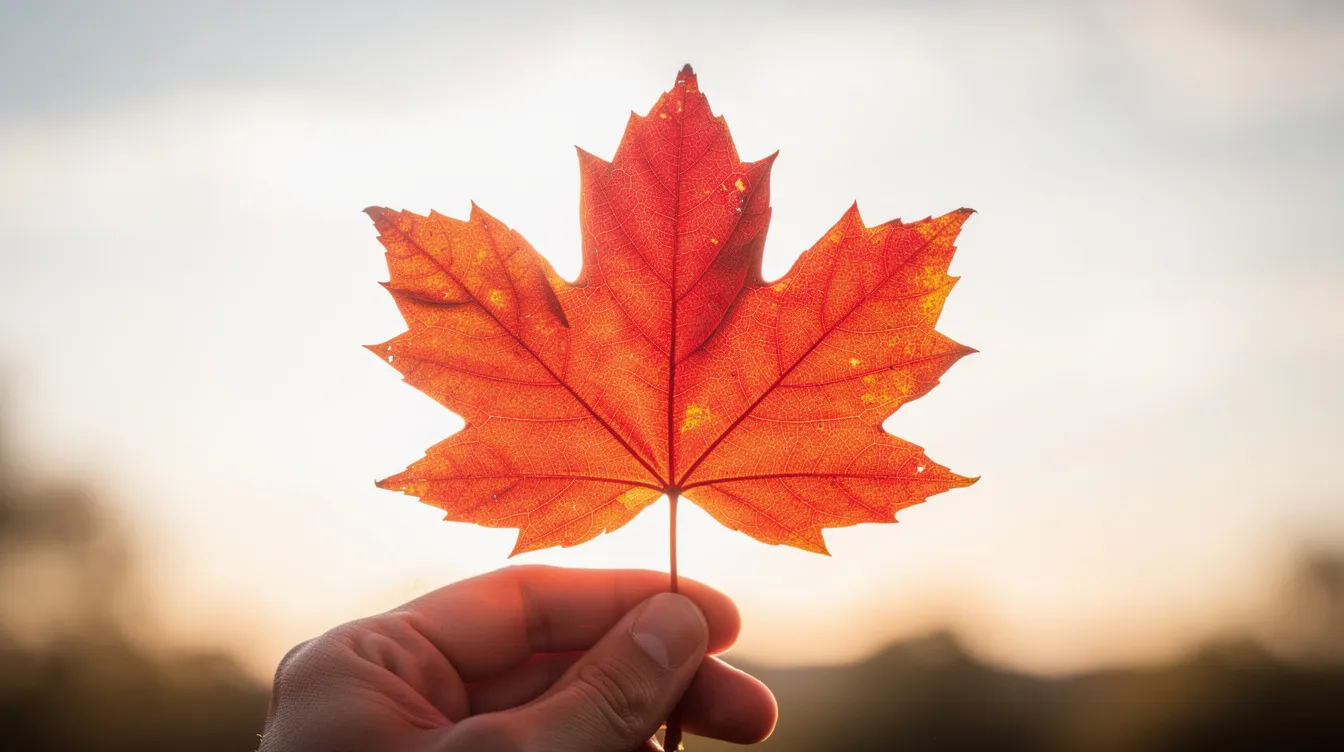
I once stopped at a farm gate and set a single scarlet oak leaf on my dashboard. Its deep sinuses caught morning light that shone straight through the red tissue, making the edges glow orange while the centre sat in a deeper, almost brown red.
Look at leaf shape first. Red maple leaves are lobed and broad. Many Japanese maples have narrow, fingered divisions. A cabbage tree cultivar like ‘Atropurpurea’ has long, strappy leaves. Shape matters as much as color when you want your sketch to read as a specific species.
Light changes everything. Backlit purple leaves can glow ruby at the edges. Shaded leaves drop toward maroon or brown. Along a single branch, new tips are more vivid and older leaves are deeper or bronzed. Note both in the margin of your sketch. Check the underside of a leaf too; it is often paler and shows veins more clearly.
Squint at the real tree. The details vanish and you see only three or four value groups: light, mid, dark. Draw those first. I work fast on location, ten minutes beside the van with the ground crunching under my boots, and that teaches me more about foliage than an hour at home with a photo, because I can watch the colors shift as the light moves and the sun drops. If sketching in public makes you nervous, my guide on tips for sketching in public covers how I got past that.
Drawing and Painting Red Leaves in a Nature Journal
I work in cheap colored pencils and a tiny field watercolor kit, so everything here assumes a small budget and limited time, like a lunch break in a parked van.
My glovebox kit for reds: pencils in lemon yellow, orange, true red, crimson, purple, and dark brown or indigo. A pocket watercolor tin with yellow, orange or warm red, crimson, and a blue or violet. A size 6 round brush and a waterbrush. A sketchbook that takes a little water. You do not need forty reds, just a warm red, a cool red, and something to darken them.
Colored pencil build: Sketch the trunk, branches, and three or four big clumps of foliage. Lay lemon yellow then orange underneath with light pressure. Add true red with short flicking strokes, leaving gaps for the yellow to peek through. Deepen the undersides and shadow areas with crimson, then purple or brown, never plain black. Pick out four or five single leaves on the lit edge to suggest detail. Finish with a little blue-grey behind the tree to make the reds look hotter. The combination of warm and cool in the same canopy is what gives depth.
For Japanese maples I layer red over a violet base so the purple leaves read correctly. For smoke tree ‘Royal Purple’ I mix red plus dark blue or violet on the page rather than reaching for one flat purple pencil. Warm red suits sunlit plants while cool red suits shaded ones. Lisa’s course on advanced realism with colored pencils is the one I point people to when they want a more polished, realistic finish than my quick glovebox sketches and want to learn patient layering and blending. You can see the full course at https://itseasytodraw.art/courses/advanced-realism-with-colored-pencils/.
Watercolor: Wet only the shape of the canopy. Drop in yellow and orange. Add red and then crimson into the damp wash without over-stirring, and let it dry fully (hard when the sun is dropping on a gravel shoulder). Then dab leaf shapes on top with a stronger red. Shadow them with red mixed with violet or a hint of burnt sienna or ultramarine. Add a dark brown or blue-violet trunk with a few thin branches poking through. Starting out with watercolor journaling is a good read for anyone brand new to the paints, since it covers the basic supplies and how I set up on a bench seat.
Aim for the feeling of the tree, not the exact color. Write margin notes like “leaves more burgundy than this” or “sun made the edges orange.” Those notes are worth more than a perfect painting. For more on what to record next to a sketch, see how to write field observations.
Keeping a Year-Round Record of Red Leaves
I follow the same tree across the season. A ‘Bloodgood’ outside a local cafe gets drawn in spring bud, summer purple, and autumn red. Three pages, same tree, three completely different color palettes.
Pick one or two trees near home or school. Give each a page or spread for a year. Add brief notes: dates, weather, leaf color, and wildlife like tui or sparrows moving through the canopy. Press a few small leaves through the season, label them with tree name and date, and glue them in to compare colors side by side. One fallen leaf pressed or traced beside the tree turns a sketch into a record. When those leaves eventually decompose on the ground, nutrient cycling returns what they carried back to the soil, feeding the roots that will produce next year’s foliage. What nature journaling is and how to start is worth reading if you are unsure how to build the habit, since the same ideas apply whether you draw trees, ferns, or the weather.
Paying attention to red leaves on a tree, whether on a grand scarlet oak in a park or a modest potted Japanese maple on somebody’s porch, has slowed my workdays in the best way and given me steady drawing practice year round. Start with the very next red or purple leaf you notice. Pick it up, hold it against the light, and see how many colors are actually in it. Then open your sketchbook and put three of them down.
FAQ
What colored pencils do I need for red leaves? A yellow, an orange, a true red, a crimson, a purple, and a dark brown cover almost everything. Layering beats owning ten similar reds.
How do I stop my red watercolor from turning muddy? Use fewer colors, let each layer dry before adding detail, darken with violet or blue rather than black, and do not overwork a damp wash.
Should I draw every leaf? No. Block in clumps and add only a handful of single leaves along the lit edges.
Can I draw red leaves from a photo? Yes, but a quick sketch on location teaches more. Use the photo later to check where the dark and light clumps sat.
What if my red looks too bright or fake? Tone it with a brown or purple shadow, and add yellow and orange leaves nearby so the red has company.